Mouse Osteopontin/OPN enzyme-linked immunoassay kit(one step)
| Specification | 96 Test |
|---|---|
| Sensitivity | 0.18 ng/ml (10 μl) |
| Standard Curve Range | 0.69~500 ng/ml |
| Standard Curve Gradient | 7 Points/3 Folds |
| Number of Incubations | 2 |
| Detectable sample | serum, plasma |
| Sample Volume | 10 μl |
| Type | Ready-to-Use |
| Operation Duration | 60min |
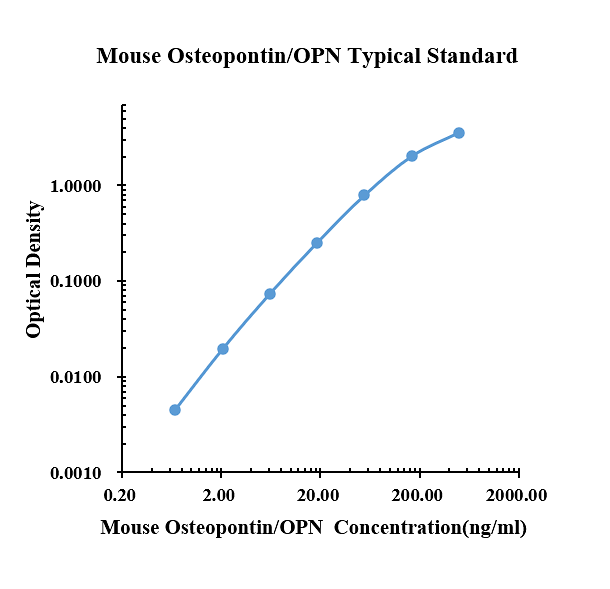
| ng/ml | O.D. | Average | Corrected | |
|---|---|---|---|---|
| 0.00 | 0.0036 | 0.0035 | 0.0035 | |
| 0.69 | 0.0082 | 0.0078 | 0.0080 | 0.0045 |
| 2.06 | 0.0231 | 0.0227 | 0.0229 | 0.0194 |
| 6.17 | 0.0776 | 0.0765 | 0.0771 | 0.0736 |
| 18.52 | 0.2525 | 0.2577 | 0.2551 | 0.2516 |
| 55.56 | 0.7773 | 0.8046 | 0.7910 | 0.7875 |
| 166.67 | 2.0170 | 2.0230 | 2.0200 | 2.0165 |
| 500.00 | 3.5410 | 3.5850 | 3.5630 | 3.5595 |
Precision
| Intra-assay Precision | Inter-assay Precision | |||||
| Sample Number | S1 | S2 | S3 | S1 | S2 | S3 |
| 22 | 22 | 22 | 6 | 6 | 6 | |
| Average(ng/ml) | 13.8 | 59.2 | 186.5 | 10.6 | 51.2 | 175.9 |
| Standard Deviation | 0.3 | 2.3 | 7.3 | 0.4 | 1.7 | 7.6 |
| Coefficient of Variation(%) | 2.5 | 3.9 | 3.9 | 3.8 | 3.4 | 4.3 |
Intra-assay Precision (Precision within an assay) Three samples of known concentration were tested twenty-two times on one plate to assess intra-assay precision.
Inter-assay Precision (Precision between assays) Three samples of known concentration were tested six times on one plate to assess intra-assay precision.
Spike Recovery
The spike recovery was evaluated by spiking 3 levels of mouse Osteopontin/OPN into health mouse serum sample. The un-spiked serum was used as blank in this experiment.
The recovery ranged from 85% to 112% with an overall mean recovery of 99%.
Sample Values
| Sample Matrix | Sample Evaluated | Range (ng/ml) | Detectable (%) | Mean of Detectable (ng/ml) |
|---|---|---|---|---|
| Serum | 30 | 46.96-265.49 | 100 | 117.02 |
Serum/Plasma – Thirty samples from apparently healthy mice were evaluated in this assay. No medical histories were available for the donors.
Product Data Sheet
Background: Osteopontin/OPN
Osteopontin (OPN), also known as bone sialoprotein (BSP), is a secreted SIBLING family protein that can be variably modified by O- and N-glycosylation, sulfation, phosphorylation, and transglutamination. OPN is widely expressed and is prominent in mineralized tissues. It inhibits bone mineralization and kidney stone formation and promotes inflammation, cell ad¬hesion, and migration. Its expression is upregulat¬ed during inflammation, obesity, atherosclerosis, cancer, and tissue damage and contributes to the pathophysiology of these conditions. The central region of OPN contains RGD and non-RGD binding sites for multiple integrins. Adjacent to the RGD motif is the sequence SLAYGLR (SVVYGLR in human) which serves as a cryptic binding site for additional integrins: it is masked in full length OPN but is exposed following OPN cleavage by multiple proteases in tumors and sites of tissue injury.