Mammalian INHBE enzyme-linked immunoassay kit (one step)
| Specification | 96 Test |
|---|---|
| Sensitivity | 0.06 ng/ml (10 μl) |
| Standard Curve Range | 3.91~250 ng/ml |
| Standard Curve Gradient | 7 Points |
| Number of Incubations | 2 |
| Detectable sample | serum, plasma |
| Sample Volume | 10 μl |
| Type | Fully Ready-to-Use |
| Operation Duration | 60 min |
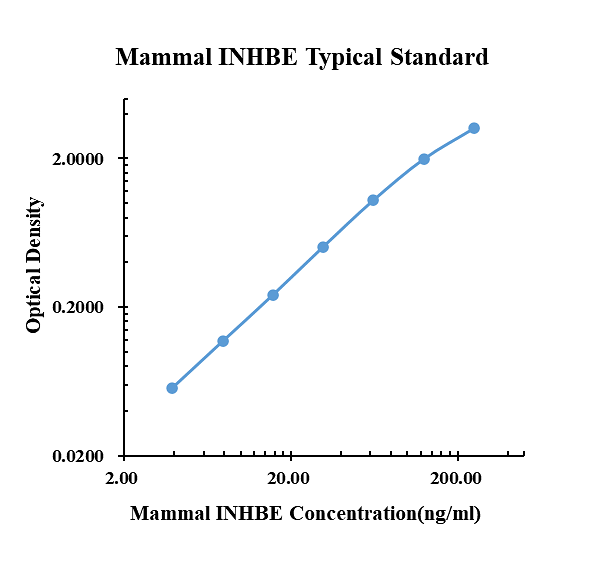
| ng/ml | O.D. | Average | Corrected | |
|---|---|---|---|---|
| 0.00 | 0.0073 | 0.0065 | 0.0069 | |
| 3.91 | 0.0656 | 0.0629 | 0.0643 | 0.0574 |
| 7.81 | 0.1209 | 0.1289 | 0.1249 | 0.1180 |
| 15.63 | 0.2501 | 0.2472 | 0.2487 | 0.2418 |
| 31.25 | 0.5334 | 0.4981 | 0.5158 | 0.5089 |
| 62.50 | 1.0980 | 1.0110 | 1.0545 | 1.0476 |
| 125.00 | 2.0750 | 1.8970 | 1.9860 | 1.9791 |
| 250.00 | 3.2990 | 3.0870 | 3.1930 | 3.1861 |
Precision
| Intra-assay Precision | Inter-assay Precision | |||||
| Sample Number | S1 | S2 | S3 | S1 | S2 | S3 |
| 22 | 22 | 22 | 6 | 6 | 6 | |
| Average(ng/ml) | 3.4 | 15.1 | 45.8 | 4.2 | 20.0 | 53.8 |
| Standard Deviation | 0.1 | 0.6 | 2.3 | 0.2 | 0.6 | 1.3 |
| Coefficient of Variation(%) | 2.6 | 3.7 | 4.9 | 4.7 | 3.2 | 2.4 |
Intra-assay Precision (Precision within an assay) Three samples of known concentration were tested Twenty-two times on one plate to assess intra-assay precision.
Inter-assay Precision (Precision between assays) Three samples of known concentration were tested six times on one plate to assess intra-assay precision.
Spike Recovery
The spike recovery was evaluated by spiking 3 levels of Mammalian INHBE into health mammal serum sample. The un-spiked serum was used as blank in this experiment.
The recovery ranged from 80% to 119% with an overall mean recovery of 96%.
Sample Values
| Sample Matrix | Sample Evaluated | Range (ng/ml) | Detectable (%) | Mean of Detectable (ng/ml) |
|---|---|---|---|---|
| Human Serum | 30 | 3.22-282.54 | 100 | 30.90 |
| Mouse Serum | 30 | 6.54-28.08 | 100 | 13.48 |
| Rat Serum | 30 | 3.39-149.33 | 100 | 31.78 |
| Monkey Serum | 2 | 9.74-10.17 | 100 | 9.95 |
Serum/Plasma – samples from apparently healthy mammals were evaluated for the presence of INHBE in this assay.
Product Data Sheet
Background: INHBE
Inhibin beta E (INHBE) is a member of the transforming growth factor-beta (TGF-beta ) superfamily of cytokines, with a molecular weight of approximately 40 kDa. INHBE plays critical roles in the regulation of diverse physiological processes, including cell growth, differentiation, and metabolism. It is a key component of the activin signaling pathway, where it dimerizes with other beta -subunits to form bioactive ligands involved in endocrine regulation. INHBE is primarily expressed in hepatic and reproductive tissues and has been implicated in metabolic homeostasis, particularly in energy expenditure and glucose metabolism. Dysregulation of INHBE expression has been linked to pathophysiological conditions such as obesity, insulin resistance, and liver disease. Furthermore, INHBE has gained attention for its tumor-suppressive role in certain cancers, suggesting its potential as a regulator of cell proliferation and apoptosis. Its specificity and involvement in metabolic and oncogenic pathways highlight INHBE as a promising biomarker and a potential target for therapeutic strategies.