Human EGFR enzyme-linked immunoassay kit
| Specification | 96 Test |
|---|---|
| Sensitivity | 39.85 pg/ml (50 μl);59.07 pg/ml (10 μl); |
| Standard Curve Range | 312.50~20000 pg/ml |
| Standard Curve Gradient | 7 Points |
| Number of Incubations | 2 |
| Detectable sample | Liquid phase sample of soluble substances. For example: serum, plasma, cell culture supernatant, tissue grinding liquid, etc. |
| Sample Volume | 50 μl/10 μl |
| Type | Fully Ready-to-Use |
| Operation Duration | 120min |
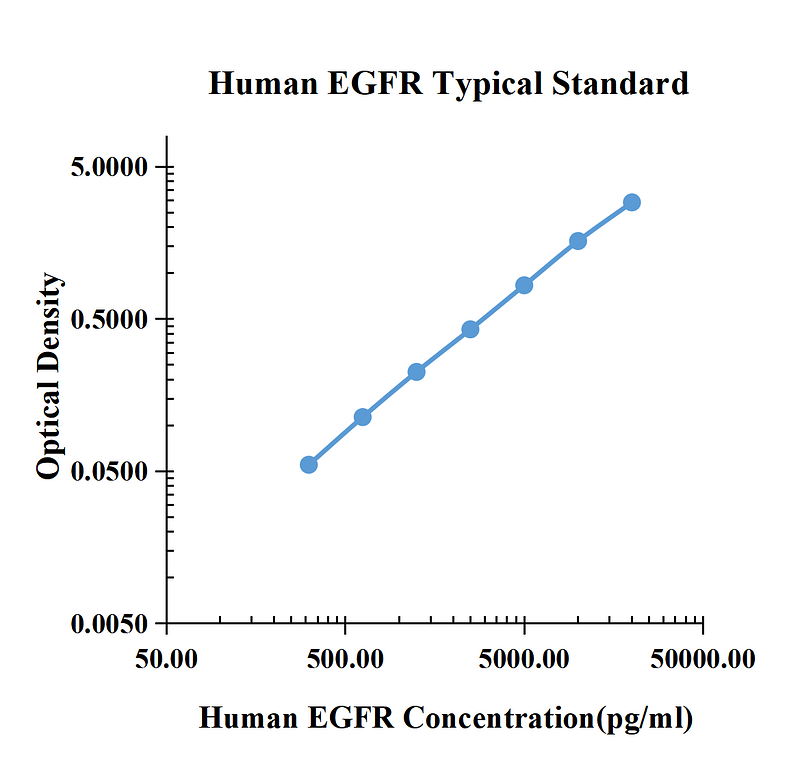
| pg/ml | O.D. | Average | Corrected | |
|---|---|---|---|---|
| 0.00 | 0.0525 | 0.0456 | 0.0491 | |
| 312.50 | 0.1030 | 0.1055 | 0.1043 | 0.0552 |
| 625.00 | 0.1569 | 0.1681 | 0.1625 | 0.1135 |
| 1250.00 | 0.2733 | 0.2743 | 0.2738 | 0.2248 |
| 2500.00 | 0.4858 | 0.4679 | 0.4769 | 0.4278 |
| 5000.00 | 0.8540 | 0.9100 | 0.8820 | 0.8330 |
| 10000.00 | 1.6050 | 1.7460 | 1.6755 | 1.6265 |
| 20000.00 | 2.8520 | 3.0830 | 2.9675 | 2.9185 |
Precision
| Intra-assay Precision | Inter-assay Precision | |||||
| Sample Number | S1 | S2 | S3 | S1 | S2 | S3 |
| 22 | 22 | 22 | 6 | 6 | 6 | |
| Average(pg/ml) | 5889.10 | 1900.99 | 368.32 | 5734.9 | 1945.4 | 394.4 |
| Standard Deviation | 371.92 | 147.54 | 24.85 | 197.9 | 133.0 | 31.0 |
| Coefficient of Variation(%) | 6.3 | 7.8 | 6.7 | 3.5 | 6.8 | 7.9 |
Intra-assay Precision (Precision within an assay) Three samples of known concentration were tested twenty-two times on one plate to assess intra-assay precision.
Inter-assay Precision (Precision between assays) Three samples of known concentration were tested six times on one plate to assess intra-assay precision.
Spike Recovery
The spike recovery was evaluated by spiking 3 levels of human EGFR into health human serum sample. The un-spiked serum was used as blank in this experiment.
The recovery ranged from 87% to 120% with an overall mean recovery of 108%.
Sample Values
| Sample Matrix | Sample Evaluated | Range (ng/ml) | Detectable (%) | Mean of Detectable (ng/ml) |
|---|---|---|---|---|
| Serum | 30 | 18.68-40.63 | 100.0 | 31.80 |
Serum/Plasma – Thirty samples from apparently healthy volunteers were evaluated in this assay. No medical histories were available for the donors.
Product Data Sheet
Background: EGFR
Epidermal growth factor receptor (EGFR), also known as ErbB1 and HER1, is a type I glycoprotein that belongs the ErbB subfamily of receptor tyrosine kinases (RTKs), which includes ErbB2/HER2, ErbB3/HER3, and ErbB4/HER4 . EGFR plays an important role in epithelial cell development and homeostasis and as a driver of tumorigenesis in cancer. The human EGFR is protein 1210 amino acids (aa) in length with a theoretical molecular weight (MW) of 134 kDa. The protein consists of a short signal peptide, an extracellular domain (ECD) divided into four subdomains (I-IV), a transmembrane region, an intracellular juxtamembrane segment, a tyrosine kinase domain, and C-terminal tail. Within the ECD, human EGFR has 88-90% aa sequence identity with mouse and rat EGFR. EGFR has four known specific ligands: EGF, amphiregulin, epigen, and transforming growth factor alpha (TGF-alpha). EGFR ligands betacellulin, epiregulin, and herapin binding (HB)-EGF have dual specificity with ErbB4. Ligand binding to the extracellular domain of EFGR leads to receptor homodimerization, or heterodimerization with other ErbB family members, and EGFR activation. This results in subsequent phosphorylation and activation of intracellular signaling pathways, such as MAPK and PI3K/Akt. EGFR signaling is essential for many cellular processes including proliferation, differentiation, migration, and apoptosis.
In addition to its role in normal development, EGFR mutations or overexpression is observed in many tumors, including breast cancer, non-small cell lung carcinoma (NSCLC), colon cancer, and more. Small molecule tyrosine kinase inhibitors (TKIs), like gefitinib, erlotinib, and afatinib, have shown great efficacy in treating patients with EGFR activating mutations, especially for NSCLC. However, most patients eventually develop acquired resistance to TKIs and thus combination and alternative therapies are in development. A third-generation TKI, osimertinib, is approved for NSCLC patients with resistance to first-line EGFR TKI treatment. Additionally, combination therapies of EGFR TKIs with monoclonal antibody immunotherapies, like anti-PD-L1, are being further investigated in clinical trials.