Human CXADR/CAR enzyme-linked immunoassay kit(one step)
| Specification | 96 Test |
|---|---|
| Sensitivity | 2.64 pg/ml (50 μl);3.77 pg/ml (10 μl); |
| Standard Curve Range | 13.72~10000 pg/ml |
| Standard Curve Gradient | 7 Points/3 Folds |
| Number of Incubations | 2 |
| Detectable sample | serum, plasma |
| Sample Volume | 50 μl/10 μl |
| Type | Fully Ready-to-Use |
| Operation Duration | 60min |
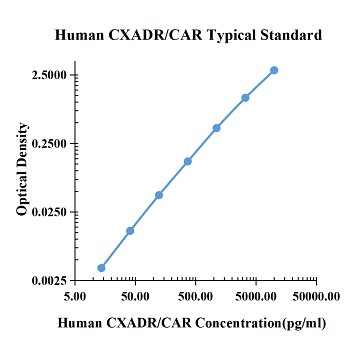
| pg/ml | O.D. | Average | Corrected | |
|---|---|---|---|---|
| 0.00 | 0.0061 | 0.0059 | 0.0060 | |
| 13.72 | 0.0100 | 0.0096 | 0.0098 | 0.0038 |
| 41.15 | 0.0194 | 0.0191 | 0.0193 | 0.0133 |
| 123.46 | 0.0491 | 0.0510 | 0.0501 | 0.0441 |
| 370.37 | 0.1454 | 0.1401 | 0.1428 | 0.1368 |
| 1111.11 | 0.4314 | 0.4186 | 0.4250 | 0.4190 |
| 3333.33 | 1.1710 | 1.1640 | 1.1675 | 1.1615 |
| 10000.00 | 2.9580 | 2.9080 | 2.9330 | 2.9270 |
Precision
| Intra-assay Precision | Inter-assay Precision | |||||
| Sample Number | S1 | S2 | S3 | S1 | S2 | S3 |
| 22 | 22 | 22 | 6 | 6 | 6 | |
| Average(pg/ml) | 248.5 | 1141.3 | 3266.2 | 246.9 | 1170.4 | 3427.4 |
| Standard Deviation | 7.2 | 26.1 | 129.8 | 7.3 | 47.9 | 102.1 |
| Coefficient of Variation(%) | 2.9 | 2.3 | 4.0 | 2.8 | 3.0 | 3.0 |
Intra-assay Precision (Precision within an assay) Three samples of known concentration were tested twenty-two times on one plate to assess intra-assay precision.
Inter-assay Precision (Precision between assays) Three samples of known concentration were tested six times on one plate to assess intra-assay precision.
Spike Recovery
The spike recovery was evaluated by spiking 3 levels of Human CXADR/CAR into health human serum sample. The un-spiked serum was used as blank in this experiment.
The recovery ranged from 80% to 101% with an overall mean recovery of 95%.
Sample Values
| Sample Matrix | Sample Evaluated | Range (pg/ml) | Detectable (%) | Mean of Detectable (pg/ml) |
|---|---|---|---|---|
| Serum | 30 | 18.04-219.66 | 100 | 82.94 |
Serum/Plasma – Thirty samples from apparently healthy volunteers were evaluated in this assay. No medical histories were available for the donors.
Product Data Sheet
Background: CXADR/CAR
CXADR (coxsackie and adenovirus receptor), also known as CAR, is a 46 kDa type I transmembrane glycoprotein that belongs to the CTX family of the Ig superfamily. CXADR has received attention as a receptor that facilitates gene transfer mediated by most adenoviruses. It is also an adhesion molecule within junctional complexes, notably between epithelial cells lining body cavities and within myocardial intercalated discs. CXADR is essential for normal cardiac development in the mouse. It is expressed throughout brain neuroepithelium during development, but mainly in ependymal cells in the adult. The 365 amino acid (aa) mouse CXADR contains a 19 aa signal sequence, a 218 aa extracellular domain (ECD) with a V-type (D1) and a C2-type (D2) Ig-like domain, a 21 aa transmembrane segment and a 107 aa intracellular domain. D1 is thought to be responsible for homodimer formation in trans within tight junctions. The fiber knob of adenoviruses attaches at a similar site, and evidence suggests that disruption of tight junctions facilitates virus binding. A PDZ binding motif at the C-terminus interacts with several cytoplasmic junctional proteins. The ECD of mouse CXADR shares 97%, 90%, 89%, 89% and 88% aa sequence identity with the corresponding regions of rat, human, bovine, porcine and canine CXADR, respectively. An alternately spliced isoform (CXADR2) that diverges in the C-terminal 15 aa shows the same expression pattern, but may show different subcellular localization. Transcription of other splice variants has been detected, but not their translation. A secreted form identified in serum and pleural fluid can block viral infection.