Rat KIM-1/HAVCR1 enzyme-linked immunoassay kit
| Specification | 96 Test |
|---|---|
| Sensitivity | 0.23 pg/ml (50 μl);1.74 pg/ml (10 μl) |
| Standard Curve Range | 4.12~3000 pg/ml |
| Standard Curve Gradient | 7 Points/3 Folds |
| Number of Incubations | 2 |
| Detectable sample | Liquid phase sample of soluble substances. For example: serum, plasma, cell culture supernatant, tissue grinding liquid, etc. |
| Sample Volume | 50 μl/10 μl |
| Type | Fully Ready-to-Use |
| Operation Duration | 120min |
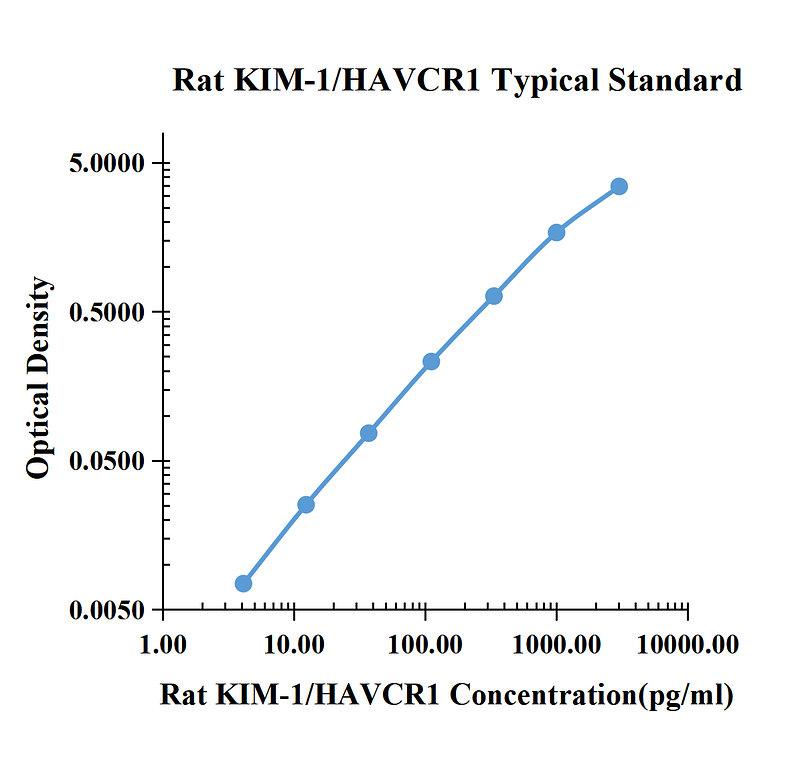
| pg/ml | O.D. | Average | Corrected | |
|---|---|---|---|---|
| 0.00 | 0.0073 | 0.0076 | 0.0075 | |
| 4.12 | 0.0153 | 0.0146 | 0.0150 | 0.0075 |
| 12.35 | 0.0331 | 0.0326 | 0.0329 | 0.0254 |
| 37.04 | 0.0847 | 0.0837 | 0.0842 | 0.0768 |
| 111.11 | 0.2503 | 0.2292 | 0.2398 | 0.2323 |
| 333.33 | 0.6670 | 0.6259 | 0.6465 | 0.6390 |
| 1000.00 | 1.7510 | 1.6770 | 1.7140 | 1.7066 |
| 3000.00 | 3.5750 | 3.4010 | 3.4880 | 3.4806 |
Precision
| Intra-assay Precision | Inter-assay Precision | |||||
| Sample Number | S1 | S2 | S3 | S1 | S2 | S3 |
| 22 | 22 | 22 | 6 | 6 | 6 | |
| Average(pg/ml) | 63.2 | 302.8 | 976.4 | 72.5 | 345.0 | 1084.2 |
| Standard Deviation | 3.5 | 17.2 | 76.5 | 0.7 | 9.3 | 26.1 |
| Coefficient of Variation(%) | 5.6 | 5.7 | 7.8 | 0.9 | 2.7 | 2.4 |
Intra-assay Precision (Precision within an assay) Three samples of known concentration were tested twenty-two times on one plate to assess intra-assay precision.
Inter-assay Precision (Precision between assays) Three samples of known concentration were tested six times on one plate to assess intra-assay precision.
Spike Recovery
The spike recovery was evaluated by spiking 3 levels of rat KIM-1/HAVCR1 into health rat serum sample. The un-spiked serum was used as blank in this experiment.
The recovery ranged from 80% to 109% with an overall mean recovery of 99%.
Sample Values
| Sample Matrix | Sample Evaluated | Range (pg/ml) | Detectable (%) | Mean of Detectable (pg/ml) |
|---|---|---|---|---|
| Serum | 30 | 756.84-1241.04 | 100 | 960.50 |
Serum/Plasma – Thirty samples from apparently healthy rats were evaluated in this assay. No medical histories were available for the donors.
Product Data Sheet
Background: KIM-1/HAVCR1
TIM-1 (T cell-immunoglobulin-mucin; also KIM-1 and HAVCR) is a 70-80 kDa, type I transmembrane glycoprotein member of the TIM family of immunoglobulin superfamily molecules. This gene family is involved in the regulation of Th1 and Th2-cell-mediated immunity. Mouse TIM-1 is synthesized as a 305 amino acid (aa) precursor that contains a 21 aa signal sequence, a 216 aa extracellular domain (ECD), a 21 aa transmembrane segment and a 47 aa cytoplasmic domain. The ECD contains one V-type Ig-like domain and a mucin region characterized by multiple T-S-P motifs. The mucin region undergoes extensive O-linked glycosylation. The mouse TIM-1 gene is highly polymorphic and, based on rat, may undergo alternate splicing. For instance, HBA mice show a 15 aa deletion in the mucin region that occurs in BALB/c mice. This difference is associated with a decreased susceptibility to asthma. Other polymorphisms are also documented. In human, TIM-1 is known to circulate as a soluble form. It undergoes constitutive cleavage by an undefined MMP, releasing a 75-85 kDa soluble molecule . The same thing might be expected in mouse. The ECD of mouse TIM-1 is 50%, 39%, and 80% aa identical to human, canine and rat TIM-1 ECD, respectively. The only two reported ligands for TIM-1 are TIM-4 and the hepatitis A virus. However, others are believed to exist, and based on the ligand for TIM-3, one possibility might be an S-type lectin. TIM-1 ligation induces T cell proliferation and promotes cytokine production. In particular, it induces IL-4 production, and requires the cytoplasmic tyrosine phosphorylation motif.