Mouse/Rat Complement C3 enzyme-linked immunoassay kit(one step)
| Specification | 96 Test |
|---|---|
| Sensitivity | 0.002 ng/ml (10 μl) |
| Standard Curve Range | 1.37~1000 ng/ml |
| Standard Curve Gradient | 7 Points/3 Folds |
| Number of Incubations | 2 |
| Detectable sample | serum, plasma |
| Sample Volume | 10 μl |
| Type | Fully Ready-to-Use |
| Operation Duration | 60 min |
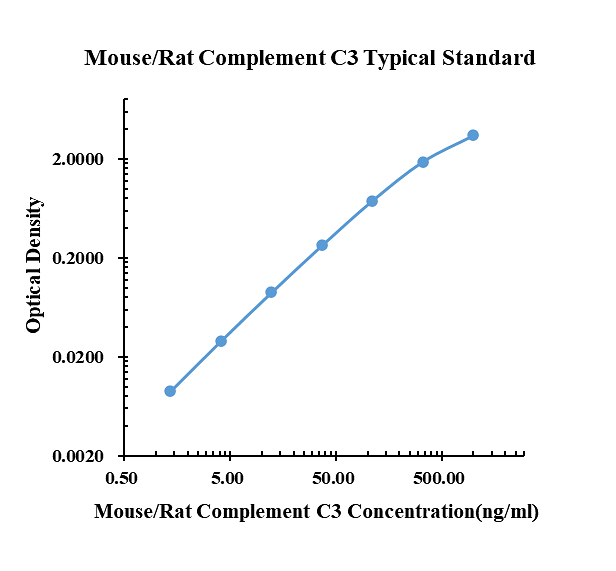
| ng/ml | O.D. | Average | Corrected | |
|---|---|---|---|---|
| 0.00 | 0.0092 | 0.0073 | 0.0083 | |
| 1.37 | 0.0172 | 0.0228 | 0.0200 | 0.0090 |
| 4.12 | 0.0371 | 0.0405 | 0.0388 | 0.0289 |
| 12.35 | 0.0976 | 0.1112 | 0.1044 | 0.0894 |
| 37.04 | 0.2751 | 0.2944 | 0.2848 | 0.2669 |
| 111.11 | 0.7644 | 0.7900 | 0.7772 | 0.7562 |
| 333.33 | 1.8840 | 2.0230 | 1.9535 | 1.8758 |
| 1000.00 | 3.4570 | 3.5770 | 3.5170 | 3.4488 |
Precision
| Intra-assay Precision | Inter-assay Precision | |||||
| Sample Number | S1 | S2 | S3 | S1 | S2 | S3 |
| 22 | 22 | 22 | 6 | 6 | 6 | |
| Average(ng/ml) | 19.1 | 105.0 | 372.5 | 18.1 | 106.6 | 403.0 |
| Standard Deviation | 0.9 | 3.2 | 15.5 | 0.7 | 4.9 | 18.1 |
| Coefficient of Variation(%) | 4.9 | 3.1 | 4.1 | 4.1 | 4.6 | 4.5 |
Intra-assay Precision (Precision within an assay) Three samples of known concentration were tested Twenty-two times on one plate to assess intra-assay precision.
Inter-assay Precision (Precision between assays) Three samples of known concentration were tested six times on one plate to assess intra-assay precision.
Spike Recovery
The spike recovery was evaluated by spiking 3 levels of mouse/rat Complement C3 into health mouse/rat serum sample. The un-spiked serum was used as blank in this experiment.
The recovery ranged from 80% to 120% with an overall mean recovery of 96%.
Sample Values
| Sample Matrix | Sample Evaluated | Range (mg/ml) | Detectable (%) | Mean of Detectable (mg/ml) |
|---|---|---|---|---|
| Mouse Serum | 30 | 1.51-5.07 | 100 | 3.34 |
| Rat Serum | 30 | 0.41-2.43 | 100 | 1.13 |
Serum/Plasma – Thirty samples from apparently healthy mice/rats were evaluated for the presence of Complement C3 in this assay. No medical histories were available for the donors. n.d. = non-detectable. Samples measured below the sensitivity are considered to be non-detectable.
Product Data Sheet
Background: Complement C3
C3a is an anaphylotoxin polypeptide comprising amino acids (aa) 671-748 of the Complement C3 precursor protein. Anaphylatoxins are proteolytically generated from the C3, C4 and C5 alpha chains by convertases formed by other complement fragments. They share 30-36% aa identity, and mediate inflammatory responses that vary in strength in the order C5a > C3a > C4a (2). Like C4a and C5a, the 78 aa, 9 kDa mouse C3a contains six conserved cysteine residues that form a knot structure and possess an overall basic charge. It is not glycosylated. The C-terminal regions of C3a and C4a show antimicrobial activity, while C5a is chemotactic but not antimicrobial. Mouse C3a shares 94% aa sequence identity with rat, and 65-69% with human, guinea pig, bovine, porcine and canine C3a. C3a formation is common to all three pathways of complement activation: classical (antibody-mediated), lectin and alternative. It binds the G-protein coupled C3a receptor (C3aR) on myeloid peripheral blood leukocytes, and on activated lymphocytes, endothelial and internal organ epithelial cells . C3a contributes to both innate and adaptive immunity. It activates mast cells and neutrophils, triggering robust mast cell degranulation in airways during asthmatic allergen challenges. It enhances lipopolysaccharide-induced prostaglandin, cytokine and chemokine secretion by macrophages and other cells . It assists in Th2-type inflammatory reactions, promotes Th1 cell maturation, and down-regulates regulatory T cell differentiation . It stimulates leukocyte chemotaxis and smooth muscle contraction. Endogenous carboxypeptidase-N can remove the arginine at the C-terminus of the anaphylatoxins to create desArg forms. C3adesArg, also called ASP (Acylation-Stimulating Protein) is an adipocyte-derived protein that binds the C5L2 receptor (GPR77) and stimulates adipose tissue triglyceride synthesis. The anaphylactic activity of ASP is weaker than that of C3a. C5L2 is also involved in C3a and C5a activity.