Human S100A12 enzyme-linked immunoassay kit(one step)
| Specification | 96 Test |
|---|---|
| Sensitivity | 0.004 ng/ml (50 μl);0.05 ng/ml (10 μl); |
| Standard Curve Range | 0.14~100 ng/ml |
| Standard Curve Gradient | 7 Points/3 Folds |
| Number of Incubations | 2 |
| Detectable sample | serum, plasma |
| Sample Volume | 50 μl/10 μl |
| Type | Ready-to-Use |
| Operation Duration | 60min |
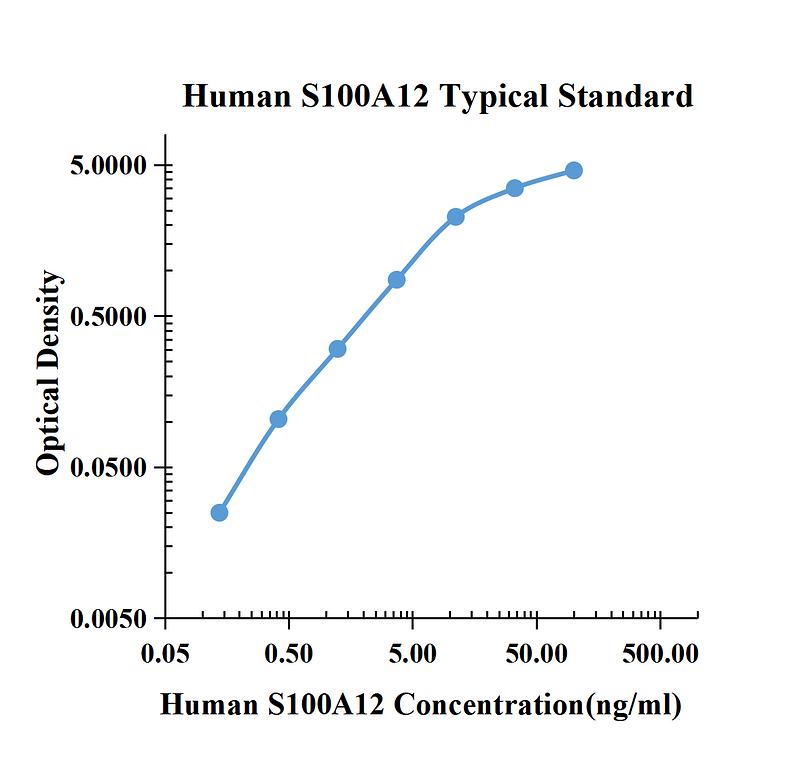
| ng/ml | O.D. | Average | Corrected | |
|---|---|---|---|---|
| 0.00 | 0.0079 | 0.0076 | 0.0078 | |
| 0.14 | 0.0318 | 0.0338 | 0.0328 | 0.0251 |
| 0.41 | 0.1116 | 0.1126 | 0.1121 | 0.1044 |
| 1.23 | 0.3195 | 0.3044 | 0.3120 | 0.3042 |
| 3.70 | 0.8767 | 0.8829 | 0.8798 | 0.8721 |
| 11.11 | 2.2750 | 2.2900 | 2.2825 | 2.2748 |
| 33.33 | 3.5036 | 3.5559 | 3.5298 | 3.5220 |
| 100.00 | 4.4908 | 4.7563 | 4.6236 | 4.6158 |
Precision
| Intra-assay Precision | Inter-assay Precision | |||||
| Sample Number | S1 | S2 | S3 | S1 | S2 | S3 |
| 22 | 22 | 22 | 6 | 6 | 6 | |
| Average(ng/ml) | 2.1 | 11.2 | 32.4 | 2.3 | 10.9 | 30.2 |
| Standard Deviation | 0.1 | 0.4 | 2.2 | 0.1 | 0.4 | 1.0 |
| Coefficient of Variation(%) | 4.8 | 3.6 | 6.8 | 4.3 | 3.7 | 3.3 |
Intra-assay Precision (Precision within an assay) Three samples of known concentration were tested twenty-two times on one plate to assess intra-assay precision.
Inter-assay Precision (Precision between assays) Three samples of known concentration were tested six times on one plate to assess intra-assay precision.
Spike Recovery
The spike recovery was evaluated by spiking 3 levels of Human S100A12 into health human serum sample. The un-spiked serum was used as blank in this experiment.
The recovery ranged from 80% to 118% with an overall mean recovery of 105%.
Sample Values
| Sample Matrix | Sample Evaluated | Range (ng/ml) | Detectable (%) | Mean of Detectable (ng/ml) |
|---|---|---|---|---|
| Serum | 30 | 16.60-62.08 | 100 | 39.18 |
Serum/Plasma – Thirty samples from apparently healthy volunteers were evaluated in this assay. No medical histories were available for the donors.
Product Data Sheet
Background: S100A12
S100A12 is a member of the S100 family of proteins containing 2 EF-hand calcium-binding motifs. S100 proteins are localized in the cytoplasm and/or nucleus of a wide range of cells, and involved in the regulation of a number of cellular processes such as cell cycle progression and differentiation. S100A12 is proposed to be involved in specific calcium-dependent signal transduction pathways and its regulatory effect on cytoskeletal components may modulate various neutrophil activities. S100A12 is also a ligand for RAGE. Interaction with RAGE on mononuclear phagocytes, lymphocytes and endothelium triggers cellular activation. Nuclear factor kappa B--a key transcription factor for inflammatory events--is activated by S100A12/RAGE. S100A12 has also been shown to have anti-microbial properties.