Human LAMC2 enzyme-linked immunoassay kit
| Specification | 96 Test |
|---|---|
| Sensitivity | 0.17 pg/ml (50 μl);2.50 pg/ml (10 μl); |
| Standard Curve Range | 13.72~10000 pg/ml |
| Standard Curve Gradient | 7 Points/3 Folds |
| Number of Incubations | 2 |
| Detectable sample | Liquid phase sample of soluble substances. For example: serum, plasma, cell culture supernatant, tissue grinding liquid, etc. |
| Sample Volume | 50 μl/10 μl |
| Type | Fully Ready-to-Use |
| Operation Duration | 120min |
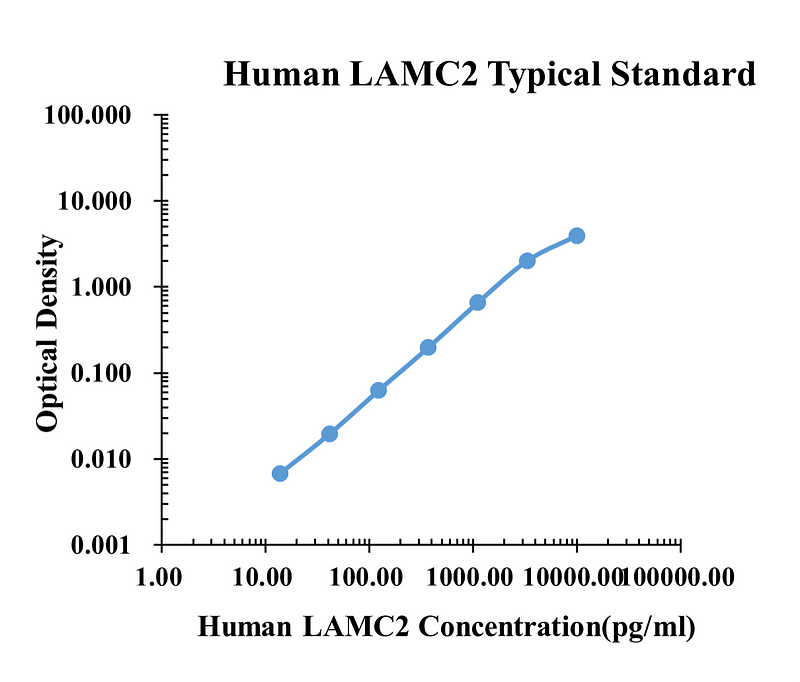
| pg/ml | O.D. | Average | Corrected | |
|---|---|---|---|---|
| 0.00 | 0.0294 | 0.0294 | 0.0294 | |
| 13.72 | 0.0333 | 0.0390 | 0.0362 | 0.0068 |
| 41.15 | 0.0455 | 0.0522 | 0.0489 | 0.0195 |
| 123.46 | 0.0964 | 0.0886 | 0.0925 | 0.0631 |
| 370.37 | 0.2276 | 0.2279 | 0.2278 | 0.1984 |
| 1111.11 | 0.6936 | 0.6883 | 0.6910 | 0.6616 |
| 3333.33 | 2.0760 | 2.0380 | 2.0570 | 2.0276 |
| 10000.00 | 3.9370 | 4.0532 | 3.9951 | 3.9657 |
Precision
| Intra-assay Precision | Inter-assay Precision | |||||
| Sample Number | S1 | S2 | S3 | S1 | S2 | S3 |
| 22 | 22 | 22 | 6 | 6 | 6 | |
| Average(pg/ml) | 150.6 | 785.4 | 2461.7 | 150.3 | 798.8 | 2646.6 |
| Standard Deviation | 7.0 | 21.8 | 103.1 | 7.5 | 14.7 | 96.5 |
| Coefficient of Variation(%) | 4.7 | 2.8 | 4.2 | 5 | 1.8 | 3.6 |
Intra-assay Precision (Precision within an assay) Three samples of known concentration were tested twenty-two times on one plate to assess intra-assay precision.
Inter-assay Precision (Precision between assays) Three samples of known concentration were tested six times on one plate to assess intra-assay precision.
Spike Recovery
The spike recovery was evaluated by spiking 3 levels of human LAMC2 into health human serum sample. The un-spiked serum was used as blank in this experiment.
The recovery ranged from 79% to 118% with an overall mean recovery of 94%.
Sample Values
| Sample Matrix | Sample Evaluated | Range (pg/ml) | Detectable (%) | Mean of Detectable (pg/ml) |
|---|---|---|---|---|
| Serum | 30 | n.d.-47.67 | 18.8 | 21.95 |
Serum/Plasma – Thirty samples from apparently healthy volunteers were evaluated in this assay. No medical histories were available for the donors.
Product Data Sheet
Background: LAMC2
Laminins, a family of extracellular matrix glycoproteins, are the major noncollagenous constituent of basement membranes. They have been implicated in a wide variety of biological processes including cell adhesion, differentiation, migration, signaling, neurite outgrowth and metastasis. Laminins are composed of 3 non identical chains: laminin alpha, beta and gamma (formerly A, B1, and B2, respectively) and they form a cruciform structure consisting of 3 short arms, each formed by a different chain, and a long arm composed of all 3 chains. Each laminin chain is a multidomain protein encoded by a distinct gene. Several isoforms of each chain have been described. Different alpha, beta and gamma chain isomers combine to give rise to different heterotrimeric laminin isoforms which are designated by Arabic numerals in the order of their discovery, i.e. alpha1beta1gamma1 heterotrimer is laminin 1. The biological functions of the different chains and trimer molecules are largely unknown, but some of the chains have been shown to differ with respect to their tissue distribution, presumably reflecting diverse functions in vivo. This gene encodes the gamma chain isoform laminin, gamma 2. The gamma 2 chain, formerly thought to be a truncated version of beta chain (B2t), is highly homologous to the gamma 1 chain; however, it lacks domain VI, and domains V, IV and III are shorter. It is expressed in several fetal tissues but differently from gamma 1, and is specifically localized to epithelial cells in skin, lung and kidney. The gamma 2 chain together with alpha 3 and beta 3 chains constitute laminin 5 (earlier known as kalinin), which is an integral part of the anchoring filaments that connect epithelial cells to the underlying basement membrane. The epithelium-specific expression of the gamma 2 chain implied its role as an epithelium attachment molecule, and mutations in this gene have been associated with junctional epidermolysis bullosa, a skin disease characterized by blisters due to disruption of the epidermal-dermal junction. Two transcript variants resulting from alternative splicing of the 3' terminal exon, and encoding different isoforms of gamma 2 chain, have been described. The two variants are differentially expressed in embryonic tissues, however, the biological significance of the two forms is not known. Transcript variants utilizing alternative polyA_signal have also been noted in literature.