Human Flt3 Ligand/FLT3LG enzyme-linked immunoassay kit
| Specification | 96 Test |
|---|---|
| Sensitivity | 0.05 pg/ml (50 μl);1.08 pg/ml (10 μl); |
| Standard Curve Range | 1.37~1000 pg/ml |
| Standard Curve Gradient | 7 Points/3 Folds |
| Number of Incubations | 2 |
| Detectable sample | Liquid phase sample of soluble substances. For example: serum, plasma, cell culture supernatant, tissue grinding liquid, etc. |
| Sample Volume | 50 μl/10 μl |
| Type | Fully Ready-to-Use |
| Operation Duration | 120min |
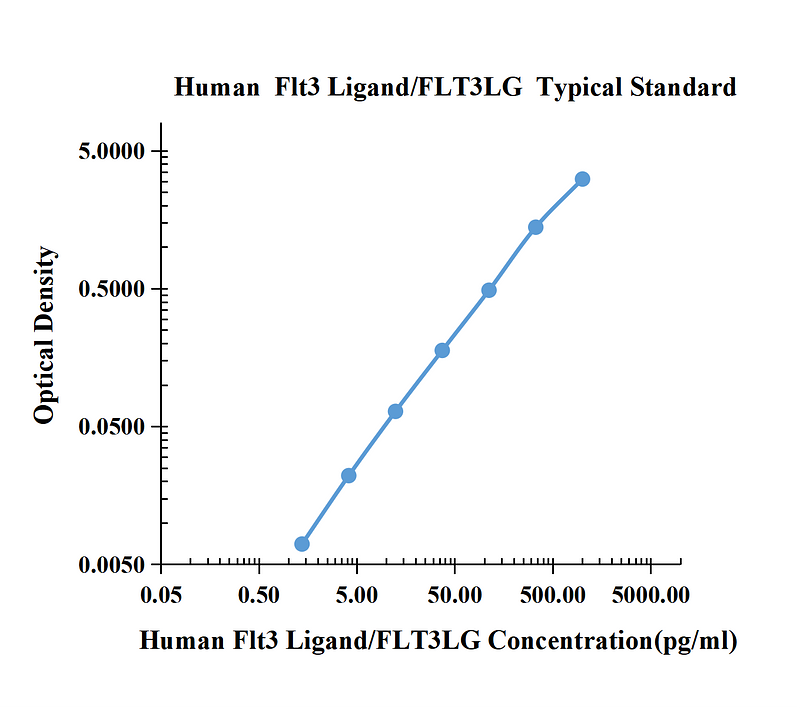
| pg/ml | O.D. | Average | Corrected | |
|---|---|---|---|---|
| 0.00 | 0.0121 | 0.0112 | 0.0117 | |
| 1.37 | 0.0186 | 0.0188 | 0.0187 | 0.0071 |
| 4.12 | 0.0339 | 0.0336 | 0.0338 | 0.0221 |
| 12.35 | 0.0776 | 0.0749 | 0.0763 | 0.0646 |
| 37.04 | 0.1919 | 0.1890 | 0.1905 | 0.1788 |
| 111.11 | 0.4592 | 0.5409 | 0.5001 | 0.4884 |
| 333.33 | 1.4100 | 1.4120 | 1.4110 | 1.3994 |
| 1000.00 | 3.1510 | 3.1270 | 3.1390 | 3.1274 |
Precision
| Intra-assay Precision | Inter-assay Precision | |||||
| Sample Number | S1 | S2 | S3 | S1 | S2 | S3 |
| 22 | 22 | 22 | 6 | 6 | 6 | |
| Average(pg/ml) | 373.36 | 110.37 | 22.99 | 318.3 | 88.0 | 19.0 |
| Standard Deviation | 25.47 | 6.27 | 1.25 | 10.6 | 6.6 | 1.3 |
| Coefficient of Variation(%) | 6.8 | 5.7 | 5.4 | 3.3 | 2.3 | 6.8 |
Intra-assay Precision (Precision within an assay) Three samples of known concentration were tested twenty-two times on one plate to assess intra-assay precision.
Inter-assay Precision (Precision between assays) Three samples of known concentration were tested six times on one plate to assess intra-assay precision.
Spike Recovery
The spike recovery was evaluated by spiking 3 levels of human Flt3 Ligand/FLT3LG into health human serum sample. The un-spiked serum was used as blank in this experiment.
The recovery ranged from 90% to 119% with an overall mean recovery of 105%.
Sample Values
| Sample Matrix | Sample Evaluated | Range (pg/ml) | Detectable (%) | Mean of Detectable (pg/ml) |
|---|---|---|---|---|
| Serum | 30 | 53.86-214.88 | 100 | 101.93 |
Serum/Plasma – Thirty samples from apparently healthy volunteers were evaluated in this assay. No medical histories were available for the donors.
Product Data Sheet
Background: Flt3 Ligand/FLT3LG
Flt‑3 Ligand, also known as FLT3L, is an alpha-helical cytokine that promotes the differentiation of multiple hematopoietic cell lineages. Mature human Flt‑3 Ligand consists of a 158 amino acid (aa) extracellular domain (ECD) with a cytokine-like domain and a juxtamembrane tether region, a 21 aa transmembrane segment, and a 30 aa cytoplasmic tail. Within the ECD, human Flt‑3 Ligand shares 71% and 65% aa sequence identity with mouse and rat Flt‑3 Ligand, respectively. The human and mouse Flt‑3 Ligand proteins show cross-species activity. Flt-3 Ligand is also structurally related to M-CSF and SCF. Flt-3 Ligand is widely expressed in various human and mouse tissues. It is expressed as a noncovalently-linked dimer by T cells and bone marrow and thymic fibroblasts. Each 36 kDa chain of the Flt-3 Ligand dimer carries approximately 12 kDa of N- and O-linked carbohydrates. Alternate splicing and proteolytic cleavage of the transmembrane form of the Flt-3 Ligand protein can generate a soluble 30 kDa fragment that includes the cytokine-like domain. Alternate splicing of human Flt‑3 Ligand also generates membrane-associated isoforms that contain either a truncated cytoplasmic tail or an 85 aa substitution following the cytokine-like domain in the ECD of the Flt-3 Ligand protein. Both transmembrane and soluble forms of Flt‑3 Ligand signal through the tyrosine kinase receptor Flt-3/Flk-2. Flt‑3 Ligand induces the expansion of monocytes and immature dendritic cells as well as early B cell lineage differentiation. Additionally, Flt-3 Ligand synergizes with IL-3, GM-CSF, and SCF to promote the mobilization and myeloid differentiation of hematopoietic stem cells. Flt-3 Ligand also cooperates with IL-2, IL-6, IL-7, and IL-15 to induce NK cell development and with IL-3, IL-7, and IL-11 to induce terminal B cell maturation. Animal studies show that Flt‑3 Ligand reduces the severity of experimentally induced allergic inflammation .