Human Complement factor H enzyme-linked immunoassay kit
| Specification | 96 Test |
|---|---|
| Sensitivity | 1.37 pg/ml (10 μl) |
| Standard Curve Range | 13.72~10000 pg/ml |
| Standard Curve Gradient | 7 Points/3 Folds |
| Number of Incubations | 2 |
| Detectable sample | Liquid phase sample of soluble substances. For example: serum, plasma, cell culture supernatant, tissue grinding liquid, etc. |
| Sample Volume | 10 μl |
| Type | Fully Ready-to-Use |
| Operation Duration | 120min |
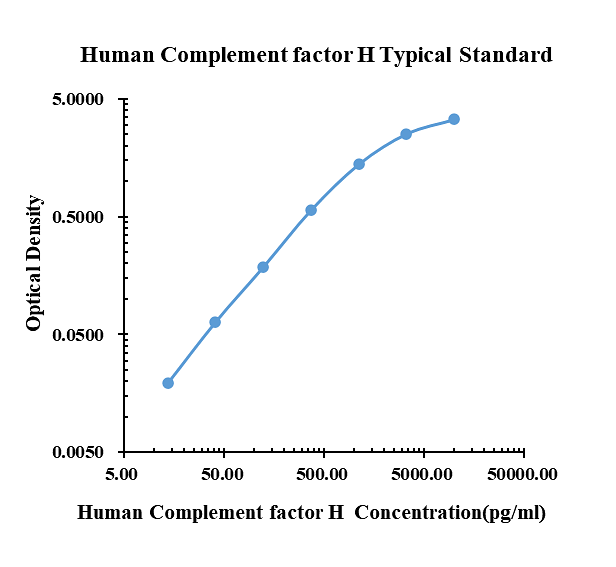
| pg/ml | O.D. | Average | Corrected | |
|---|---|---|---|---|
| 0.00 | 0.0249 | 0.0241 | 0.0245 | |
| 13.72 | 0.0447 | 0.0429 | 0.0438 | 0.0193 |
| 41.15 | 0.0872 | 0.0895 | 0.0884 | 0.0639 |
| 123.46 | 0.2038 | 0.2194 | 0.2116 | 0.1871 |
| 370.37 | 0.5905 | 0.5950 | 0.5928 | 0.5683 |
| 1111.11 | 1.4090 | 1.4310 | 1.4200 | 1.3955 |
| 3333.33 | 2.5530 | 2.5420 | 2.5475 | 2.5230 |
| 10000.00 | 3.3510 | 3.3810 | 3.3660 | 3.3415 |
Precision
| Intra-assay Precision | Inter-assay Precision | |||||
| Sample Number | S1 | S2 | S3 | S1 | S2 | S3 |
| 22 | 22 | 22 | 6 | 6 | 6 | |
| Average(pg/ml) | 180.0 | 919.1 | 2801.6 | 269.2 | 1214.9 | 3867.2 |
| Standard Deviation | 9.5 | 45.6 | 146.1 | 10.9 | 52.4 | 209.7 |
| Coefficient of Variation(%) | 5.3 | 5.0 | 5.2 | 4.0 | 4.3 | 5.4 |
Intra-assay Precision (Precision within an assay) Three samples of known concentration were tested twenty-two times on one plate to assess intra-assay precision.
Inter-assay Precision (Precision between assays) Three samples of known concentration were tested six times on one plate to assess intra-assay precision.
Spike Recovery
The spike recovery was evaluated by spiking 3 levels of human Complement factor H into health human serum sample. The un-spiked serum was used as blank in this experiment.
The recovery ranged from 82% to 96% with an overall mean recovery of 90%.
Sample Values
| Sample Matrix | Sample Evaluated | Range (μg/ml) | Detectable (%) | Mean of Detectable (μg/ml) |
|---|---|---|---|---|
| Serum | 30 | 153.70-616.01 | 100 | 377.60 |
Serum/Plasma – Thirty samples from apparently healthy volunteers were evaluated in this assay. No medical histories were available for the donors.
Product Data Sheet
Background: Complement factor H
Complement Factor H is a 155 kDa glycoprotein that provides critical negative regulation to the alternative pathway of complement cascade. It is secreted by Kupffer cells, hepatocytes, vascular endothelial cells, and platelets, and circulates in the serum at high concentration. Complement Factor H is composed of 20 SCRs (short consensus repeats), each of which consists of approximately 60 amino acids with four invariant Cys residues. Alternate splicing generates a Complement Factor H isoform that is truncated following SCR7.
Complement Factor H interacts with cell surface polyanions including heparin and sialoglycoproteins, and immobilized Complement Factor H supports the CD11b/CD18 integrin-dependent adhesion of neutrophils. It prevents local complement activation by sequestering complement component C3b, accelerating the decay of C3 and C5 convertases, and functions as a cofactor for the C3b inactivator, Factor I.
Short consensus repeats 15-20 (SCR15-20) encompass the primary binding sites for heparin and C3b, as well as for the peptide hormone adrenomedullin. Within SCR15-20, human Complement Factor H shares 60% and 63% amino acid sequence identity with mouse and rat Complement Factor H, respectively. Dozens of mutations clustered in SCR15-20 are associated with atypical hemolytic uremic syndrome, a disorder characterized by anemia, thrombocytopenia, and renal failure. Binding of Complement Factor H to tumor cell-associated dentin matrix protein 1, bone sialoprotein, or osteopontin results in the protection of that cell from complement-mediated lysis. A variety of pathogenic microbes also express Complement Factor H binding molecules that interfere with immune clearance of the infection.