Human CD254/RANKL/TNFSF11 enzyme-linked immunoassay kit
| Specification | 96 Test |
|---|---|
| Sensitivity | 0.20 pg/ml (50 μl);0.76 pg/ml (10 μl); |
| Standard Curve Range | 6.86~5000 pg/ml |
| Standard Curve Gradient | 7 Points/3 Folds |
| Number of Incubations | 2 |
| Detectable sample | Liquid phase sample of soluble substances. For example: serum, plasma, cell culture supernatant, tissue grinding liquid, etc. |
| Sample Volume | 50 μl/10 μl |
| Type | Fully Ready-to-Use |
| Operation Duration | 120min |
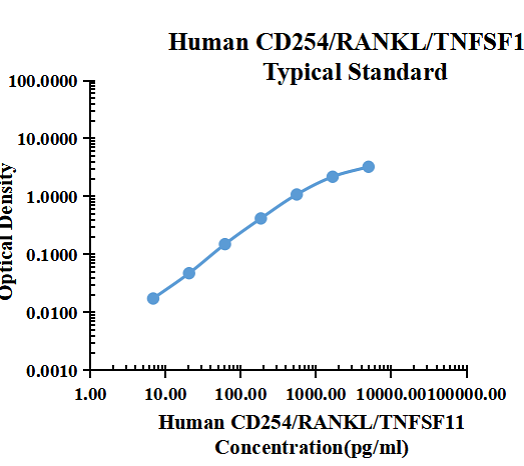
| pg/ml | O.D. | Average | Corrected | |
|---|---|---|---|---|
| 0.00 | 0.0113 | 0.0117 | 0.0115 | |
| 6.86 | 0.0282 | 0.0296 | 0.0289 | 0.0174 |
| 20.58 | 0.0583 | 0.0597 | 0.0590 | 0.0475 |
| 61.73 | 0.1615 | 0.1627 | 0.1621 | 0.1506 |
| 185.19 | 0.4068 | 0.4528 | 0.4298 | 0.4183 |
| 555.56 | 1.0560 | 1.1330 | 1.0945 | 1.0830 |
| 1666.67 | 2.2150 | 2.1870 | 2.2010 | 2.1895 |
| 5000.00 | 3.2400 | 3.2890 | 3.2645 | 3.2530 |
Precision
| Intra-assay Precision | Inter-assay Precision | |||||
| Sample Number | S1 | S2 | S3 | S1 | S2 | S3 |
| 22 | 22 | 22 | 6 | 6 | 6 | |
| Average(pg/ml) | 98.6 | 567.8 | 1800.9 | 81.2 | 446.1 | 1484.8 |
| Standard Deviation | 5.2 | 41.2 | 140.4 | 3.2 | 13.9 | 70.5 |
| Coefficient of Variation(%) | 5.3 | 7.3 | 7.8 | 3.9 | 3.1 | 4.7 |
Intra-assay Precision (Precision within an assay) Three samples of known concentration were tested Twenty-two times on one plate to assess intra-assay precision.
Inter-assay Precision (Precision between assays) Three samples of known concentration were tested six times on one plate to assess intra-assay precision.
Spike Recovery
The spike recovery was evaluated by spiking 3 levels of Human CD254/RANKL/TNFSF11 into health human serum sample. The un-spiked serum was used as blank in this experiment.
The recovery ranged from 80% to 102% with an overall mean recovery of 91%.
Sample Values
| Sample Matrix | Sample Evaluated | Range (pg/ml) | Detectable (%) | Mean of Detectable (pg/ml) |
|---|---|---|---|---|
| Serum | 30 | 0.63-9.14 | 100 | 4.14 |
Serum/Plasma – Thirty samples from apparently healthy volunteers were evaluated for the presence of CD254/RANKL/TNFSF11 in this assay. No medical histories were available for the donors.
Product Data Sheet
Background: CD254/RANKL/TNFSF11
RANKL (TNFSF11) is a type II transmembrane protein that is a ligand for the NF-κB (RANK) receptor. RANKL is an activator of NF-κB. RANKL binds to NF-κB and induces differentiation into osteoclasts in monocyte/macrophage lineage cells, further leading to osteoclast precursor maturation. Therefore, RANKL is essential for osteoclast maturation, bone modeling and bone remodeling, and lymph node (LN) development. In bone tissue, RANKL is expressed by osteoblasts, osteocytes, and immune cells, especially in osteoblasts and osteocytes. Human RANKL had amino acid homology of 82.02% and 84.44% in mice and rats, respectively. The amino acid homology of mouse RANKL and rat was 94.94%. Human RANKL consists of a cytoplasmic domain (M1-S47), a helical domain (M48-F68), and an extracellular domain (Y69-D317). Soluble fragments (140-317) can be released after being cleaved by enzymes such as matrix metalloproteinases (MMP3 or 7) and ADAM.