Human Apolipoprotein E/Apo E enzyme-linked immunoassay kit(one step)
| Specification | 96 Test |
|---|---|
| Sensitivity | 0.46 ng/ml (10 μl) |
| Standard Curve Range | 15.63~1000 ng/ml |
| Standard Curve Gradient | 7 Points |
| Number of Incubations | 2 |
| Detectable sample | serum, plasma |
| Sample Volume | 10 μl |
| Type | Fully Ready-to-Use |
| Operation Duration | 60min |
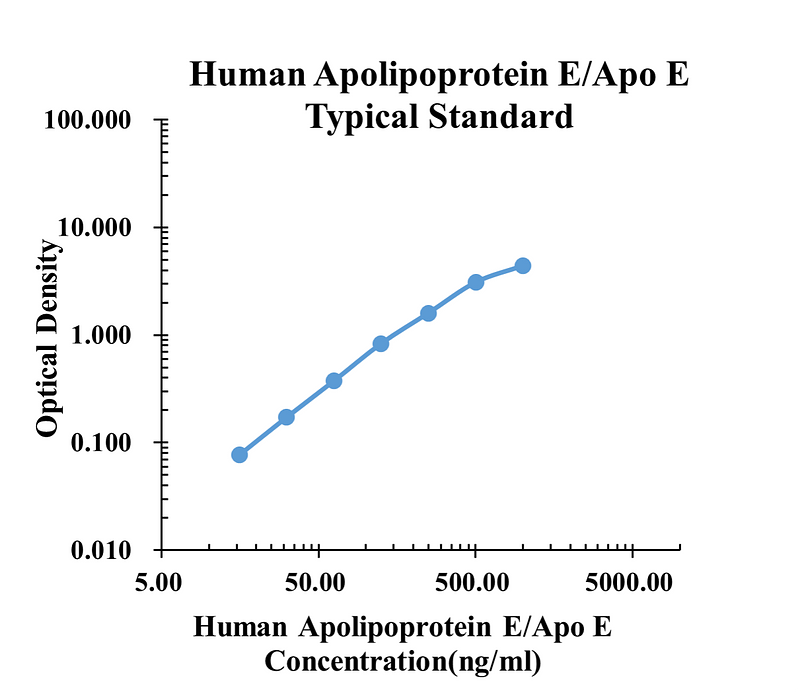
| ng/ml | O.D. | Average | Corrected | |
|---|---|---|---|---|
| 0.00 | 0.0187 | 0.0194 | 0.0191 | |
| 15.63 | 0.0974 | 0.0943 | 0.0959 | 0.0768 |
| 31.25 | 0.1995 | 0.1820 | 0.1908 | 0.1717 |
| 62.50 | 0.4094 | 0.3758 | 0.3926 | 0.3736 |
| 125.00 | 0.8391 | 0.8584 | 0.8488 | 0.8297 |
| 250.00 | 1.6260 | 1.5950 | 1.6105 | 1.5915 |
| 500.00 | 3.1190 | 3.0560 | 3.0875 | 3.0685 |
| 1000.00 | 4.3897 | 4.3803 | 4.3850 | 4.3660 |
Precision
| Intra-assay Precision | Inter-assay Precision | |||||
| Sample Number | S1 | S2 | S3 | S1 | S2 | S3 |
| 22 | 22 | 22 | 6 | 6 | 6 | |
| Average(ng/ml) | 20.9 | 124.5 | 383.8 | 20.0 | 136.7 | 398.5 |
| Standard Deviation | 1.6 | 9.3 | 27.8 | 1.1 | 6.8 | 9.7 |
| Coefficient of Variation(%) | 7.6 | 7.5 | 7.3 | 5.5 | 5.0 | 2.4 |
Intra-assay Precision (Precision within an assay) Three samples of known concentration were tested twenty-two times on one plate to assess intra-assay precision.
Inter-assay Precision (Precision between assays) Three samples of known concentration were tested six times on one plate to assess intra-assay precision.
Spike Recovery
The spike recovery was evaluated by spiking 3 levels of human Apolipoprotein E/Apo E into health human serum sample. The un-spiked serum was used as blank in this experiment.
The recovery ranged from 80% to 119% with an overall mean recovery of 103%.
Sample Values
| Sample Matrix | Sample Evaluated | Range (μg/ml) | Detectable (%) | Mean of Detectable (μg/ml) |
|---|---|---|---|---|
| Serum | 30 | 23.36-55.33 | 100 | 37.04 |
Serum/Plasma – Thirty samples from apparently healthy volunteers were evaluated in this assay. No medical histories were available for the donors.
Product Data Sheet
Background: Apolipoprotein E/Apo E
ApoE (apolipoprotein E) is the protein constituent of cholesterol/triglyceride-rich plasma lipoproteins, and is a multifunctional glycosylated secretary protein found almost in all organs with high activity in hepatic tissues. ApoE expression is induced by cholesterol-rich diets and is enhanced in lipoproteins in humans with genetic disorder type III hyperlipoproteinemia (HLP) characterized by remnant lipoproteins accumulation in plasma and premature atherosclerosis. ApoE circulates in blood as a protein component of VLDLs, chylomicron remnants, a subclass of HDL etc, and in cerebrospinal fluid as well as CNS interstitial fluid on small particles and disks resembling HDLs. ApoE facilitates transport of cholesterol and other lipids, as well as the clearance of plasma lipoproteins by serving as a critical ligand for lipoprotein uptake by LDL receptors and related proteins. ApoE participates in lipids redistribution to cells (e.g. CNS) that require cholesterol and phospholipids for reparative processes. ApoE also involves in proliferation inhibition of smooth muscle cells/lymphocytes, antigen presentation, and cholesterol efflux stimulation from foam cell macrophages. Defects in APOE have been linked to HLPP3 (hyperlipoproteinemia type 3), AD2 (Alzheimer disease type 2), SBHD (sea-blue histiocyte disease), LPG (lipoprotein glomerulopathy), and certain autoimmune disorders including multiple sclerosis and psoriasis.